


Cybercrime-related losses in Africa have more than doubled since 2024, rising from US$192 million to US$484 million, as Ghana strengthens collaboration among financial institutions, law enforcement and technology providers to protect its rapidly expanding digital finance ecosystem.
The figures were disclosed by COP Lydia Yaako Donkor, Director-General of the Criminal Investigation Department (CID) of the Ghana Police Service, at the launch of the 2026 National Cyber Security Awareness Month (NCSAM).
The month-long campaign is being held under the theme “Securing Ghana’s Digital Finance Ecosystem: Building Trust Through Collaboration and Cyber Resilience”, with stakeholders highlighting the growing threat posed by cybercrime to digital financial services.
COP Donkor said the threat had evolved beyond isolated acts of online fraud, with criminal groups increasingly using social engineering, stolen identities, compromised devices, fraudulent businesses, cryptocurrency and other tools to target individuals and institutions.
She said artificial intelligence was also becoming an important tool for cybercriminals, enabling them to produce convincing phishing messages, clone voices, create synthetic images and videos, and personalise fraudulent schemes on a larger scale.
According to COP Donkor, an Interpol assessment found that AI is enabling 55% of reported cybercrimes across Africa, while online scams, ransomware, business email compromise, virtual asset scams and digital extortion remain among the leading threats.
“Cybercrime is no longer merely isolated offending. It is increasingly an industrialised, borderless criminal ecosystem,” she said.
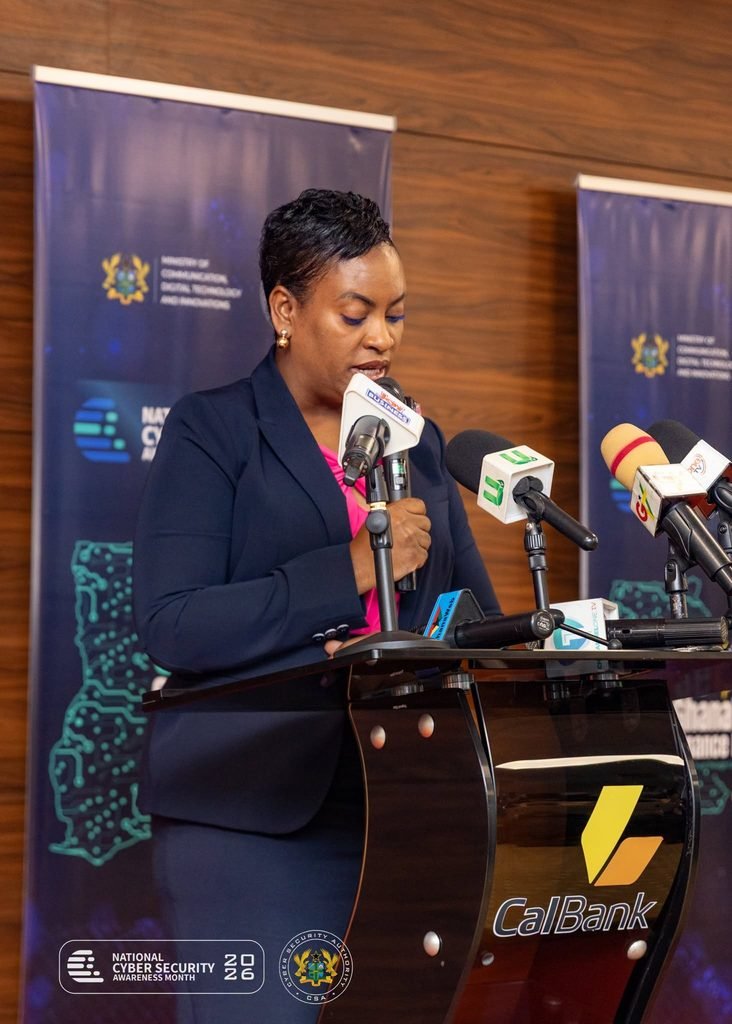
COP Donkor said the Ghana Police Service was adapting its investigative methods to match the changing nature of crime, noting that digital evidence had become increasingly important in conventional as well as cybercrime investigations.
She said mobile phones could become crime scenes, wallet transactions could provide investigative leads, IP logs could connect events, while social media accounts could help investigators uncover wider criminal networks.
The Police Service is therefore decentralising cybercrime investigators and specialists across its commands while strengthening specialised cyber investigations, 24-hour cyber intelligence, virtual asset investigations and digital forensics.
In one joint CID operation targeting suspected cybercriminals near Tema, 39 suspects were arrested and several digital devices seized.
In another coordinated operation, the CID arrested 68 suspects, seized 835 devices, identified 108 victims, traced more than US$450,000 in losses and recovered a significant portion of the funds.
She said the results sent a clear warning to criminals operating online.
“Cybercrime may be borderless, but criminals are not beyond reach.”
The call for stronger collaboration was echoed by John Awuah, Chief Executive Officer of the Ghana Association of Banks, who said the rapid adoption of digital financial services had created new opportunities for criminals to exploit weaknesses across the financial ecosystem.
He said every digital transaction created a trail that could potentially be exploited, making cooperation between banks, telecommunications companies, fintechs, payment service providers, technology companies and law enforcement essential.
“The criminals are sharing information, they are sharing tactics, they are sharing their modus operandi. So we, the defence people, we cannot afford not to share information. We can’t afford not to share intelligence,” Mr Awuah said.
Mr Awuah also called for the development of a stronger fraud architecture across the digital finance ecosystem, warning that every point in a digital transaction — from banks and telecommunications companies to merchants and payment providers — could present a security risk.
He said the security of the entire system could be compromised if one participant prioritised profitability over security.
“In digital financial services, your number one priority should be security.”
Mr Awuah urged the public to take cyber security awareness seriously, describing informed customers as an important part of the fight against fraud.
“An informed customer is a secure customer,” he said.
Sadick Arthur, Chief Risk Officer of CalBank PLC, said the financial sector had benefited significantly from digitalisation through increased access to financial services, greater efficiency and new opportunities for businesses and individuals.
However, he said the growing interconnectedness of financial services also increased exposure to cyber risks.
Mr Arthur said emerging technologies, particularly artificial intelligence, presented both opportunities and risks, as criminals could use them to facilitate more sophisticated fraud, impersonation, social engineering and cyberattacks.
He said the answer was not to slow technological innovation but to ensure that innovation was accompanied by stronger security and resilience.
“Cyber security cannot be addressed alone by one organisation, one sector, or one individual,” he said.

The speakers also stressed that cyber security should go beyond preventing attacks to ensuring that institutions can detect, respond, recover and learn from incidents.
The 2026 National Cyber Security Awareness Month will focus attention on strengthening public awareness and cooperation across Ghana’s digital financial ecosystem, with stakeholders seeking to ensure that the country’s continued digital transformation is matched by stronger cyber security and resilience.