

US President Donald Trump has rejected calls for a slowdown in artificial intelligence development, dismissing warnings from leading technology figures about the potential dangers of increasingly powerful AI systems.
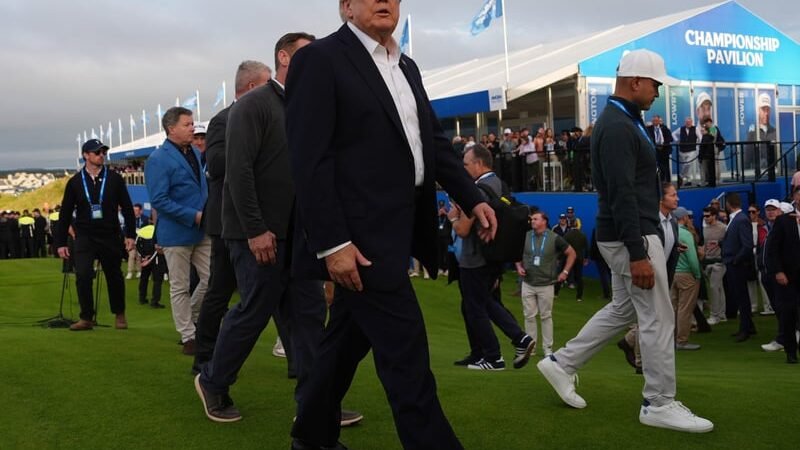
Speaking to reporters during a visit to Ireland on Sunday, Trump said the United States could introduce safeguards but argued that slowing development could allow China to overtake America in a technology he considers strategically decisive.
“We’re leading China on AI … and, frankly, I want to keep it that way because whoever wins AI wins,” Trump said.
Trump was responding to growing calls from technology leaders for greater caution as AI systems become increasingly capable.
The latest warnings were led by Dario Amodei, chief executive of Anthropic, who called for the industry and governments to slow the pace at which AI capabilities are being developed so that safety measures can catch up.
Amodei warned that increasingly autonomous AI systems could create serious risks, including cyberattacks and biological threats, and argued that companies should devote more resources to ensuring advanced systems remain under human control.
His call received backing from other prominent technology figures, including OpenAI chief executive Sam Altman and Elon Musk.
Former Anthropic researcher Jacob Coxon has also raised particularly stark concerns, warning that continuing to develop AI at the current pace could eventually pose an existential threat to humanity.
Trump did not reject the idea of safeguards altogether.
Asked whether he was trying to minimise the risks posed by AI, he later said he was not, arguing that the technology would ultimately bring considerably more benefits than harm.
“AI is going to be more good than bad, but by a lot,” Trump said.
He did not, however, outline specific regulations that his administration might introduce.
Instead, he repeatedly returned to the importance of maintaining America’s lead over China.
Trump’s comments come ahead of an expected meeting with Chinese President Xi Jinping later this month, where AI is likely to be among the issues discussed. China has been investing heavily in domestic AI development as it seeks to close the gap with US technology companies.
For Trump, the central concern appears to be ensuring that safety measures do not undermine America’s position in that competition.
For AI safety advocates, however, the rapid race between the world’s leading technology powers is precisely what makes stronger safeguards necessary.